Preserving Human Conception, Contribution, and Decision-Making in the Age of AI: Introduction to the Human Conception Ledger for Human Provenance

This paper is also available at: https://doi.org/10.5281/zenodo.21880405
Abstract The recent implementation of machine-readable marking by Anthropic for Claude models, imperceptible text watermarks and digitally signed provenance metadata under the EU AI Act’s Article 50(2) Code of Practice: represents an important advance in identifying AI involvement in generated content. These marks apply worldwide and travel with copied text. Yet Anthropic itself acknowledges a fundamental limitation: detection of a Claude mark “is not fully conclusive” and “does not, on its own, confirm the full provenance of the content,” because Claude is frequently used for proofreading, translation, summarization, or conversion of material whose underlying ideas originated elsewhere. AI watermarking therefore answers only one side of the provenance question: whether a machine participated. It does not answer what the human conceived, contributed, decided, rejected, or directed. This short note introduces the Human Conception Ledger (HCL) as a complementary framework for documenting human-origin conception, judgment, and decision events within AI-assisted workflows. Full technical specification of HCL (and its team-level extension, the Team Contribution Attribution Ledger) appears in companion papers. The goal is not to resist AI, but to ensure that human intellectual contribution remains visible and attributable as AI capability grows.
Figure 1. Human and AI involvement across AI-assisted project workflows. Two projects may produce similar final outputs and contain equivalent indicators of AI involvement while reflecting fundamentally different levels of human contribution. In a human-led workflow, human conception, judgment, evaluation, interpretation, and decision-making occur throughout the project, with AI used selectively for specific tasks. In an AI-led workflow, a human may provide an initial prompt or objective while AI performs most subsequent steps. AI watermarking may identify AI involvement in both outputs but does not, by itself, distinguish the extent or nature of human intellectual contribution. The Human Conception Ledger (HCL) is intended to preserve this complementary record of human provenance.
1. The Emergence of AI Content Provenance
This paper was prompted in part by Anthropic’s implementation of machine-readable marking for Claude models under the EU AI Act’s Article 50(2) Code of Practice, on Transparency of AI-Generated Content. New Claude models launched on or after 2 August 2026 embed imperceptible watermarks directly into generated text and attach digitally signed provenance metadata (C2PA) to supported file types. These marks apply worldwide across Claude products and major cloud platforms. Anthropic itself acknowledges a key limitation: detection of a Claude mark “is not fully conclusive” and “does not, on its own, confirm the full provenance of the content,” because Claude is frequently used for proofreading, translation, summarization, or file conversion of material whose underlying ideas originated elsewhere.
The development is part of a broader regulatory shift. Article 50 transparency obligations applicable from August 2, 2026 require covered providers to facilitate identification of AI-generated or manipulated content through machine-readable marking, subject to the regulation’s scope and exceptions. The European Commission describes these requirements as mechanisms for reducing deception and manipulation and increasing public trust in AI-mediated information.
These objectives are important. As synthetic content becomes increasingly difficult to distinguish from human-created content, consumers and other recipients may reasonably want to know when AI was involved.
Yet identification of AI involvement creates a second attribution problem. A document carrying an AI marker may have resulted from a prompt requesting autonomous generation of an entire document. Alternatively, a human may have spent months developing the underlying concept, generated experimental evidence, constructed an analytical framework, supplied extensive source material, instructed an AI system to reorganize portions of that material, rejected inappropriate suggestions, rewritten substantive sections, and ultimately used AI for editing.
Both outputs may nevertheless contain evidence of AI processing.
Indeed, Anthropic explicitly recognizes this limitation: detection of a Claude mark does not establish complete provenance, and marked material may contain ideas, text, or data originating elsewhere because Claude may have been used for functions such as proofreading, translation, summarization, or file conversion.
This distinction points toward a larger problem that AI watermarking alone cannot solve.
2. The Other Side of AI Provenance: Human Provenance
A watermark can provide evidence about the participation of a machine.
It does not necessarily provide evidence about the participation of the human.
This distinction becomes increasingly consequential as AI becomes an ordinary professional tool.
Consider two individuals producing superficially similar AI-assisted reports. The first asks an AI system to independently generate a report and accepts the resulting output with minimal modification. The second identifies the problem, originates the central hypothesis, supplies specialized information unavailable to the model, determines the analytical approach, iteratively evaluates alternative solutions, rejects erroneous outputs, introduces new concepts, and directs the system toward a final result.
Both final artifacts may properly be described as AI-assisted. They may even carry equivalent technical indicators of AI processing.
The human intellectual contributions behind them, however, are fundamentally different.
If AI involvement alone becomes the dominant provenance signal, substantial human work risks becoming invisible.
Figure 1. Human and AI involvement across AI-assisted project workflows. Two projects may produce similar final outputs and contain equivalent indicators of AI involvement while reflecting fundamentally different levels of human contribution. In a human-led workflow, human conception, judgment, evaluation, interpretation, and decision-making occur throughout the project, with AI used selectively for specific tasks. In an AI-led workflow, a human may provide an initial prompt or objective while AI performs most subsequent steps. AI watermarking may identify AI involvement in both outputs but does not, by itself, distinguish the extent or nature of human intellectual contribution. The Human Conception Ledger (HCL) is intended to preserve this complementary record of human provenance.

3. Why Human Provenance Matters
This problem extends well beyond academic debates about whether a particular passage was “written by AI.”
In employment, an employer evaluating an AI-assisted work product may want to understand whether an employee supplied the underlying expertise and reasoning or merely transmitted an AI-generated result. Conversely, an employee may need a way to demonstrate that a valuable work product originated from their conception and judgment even though AI assisted with its expression.
Similar questions can arise in consulting and contractual relationships, where parties may disagree over who developed a strategy or solution. Intellectual-property disputes may involve questions concerning the chronology and nature of human conception.
Scientific and technical collaborations increasingly require meaningful attribution among multiple human contributors using shared computational systems.
Organizations may also need records establishing which decisions were made by humans, which were proposed by AI systems, and who accepted or rejected consequential recommendations.
The societal challenge therefore is not simply to identify AI-generated content. t is also to preserve human agency inside AI-assisted work.
4. The Human Conception Ledger
The Human Conception Ledger (HCL) is proposed as an infrastructure for documenting this complementary form of provenance.
HCL begins with a different question from conventional AI detection:
What did the human conceive, contribute, decide, select, reject, modify, or direct during the creation of this work?
Rather than treating the final artifact as the sole unit of analysis, HCL treats the development process as a sequence of potentially attributable events.
These may include human-originated concepts; hypotheses and problem formulations; instructions and constraints supplied to AI systems; source materials introduced by the human; alternatives considered; AI recommendations accepted or rejected; substantive human modifications; experimental observations; reasoning transitions; decisions and approvals; and resulting artifacts.
The objective is not to prove that AI was absent. Indeed, HCL assumes that sophisticated human work will increasingly occur with AI and seeks to preserve evidence of human contribution within that environment.
This short note introduces the conceptual need and high-level framing. The full technical architecture: Human Contribution Events, Human Insight Nodes, Human Decision Overrides, Rejection Events, AI-as-Digital-Witness, multi-model divergence, cryptographic hashing, selective reveal, and the Private Immutable Inventor Ledger—is detailed in the companion paper Human Conception Ledger (HCL): A Framework for Provenance, Attribution, and Human Inventorship in AI-Augmented Systems. Team-level aggregation is treated in the companion TCAL paper.
Human Conception Ledger (HCL): A Framework for Provenance, Attribution, and Human Inventorship in AI-Augmented Systems
Team Contribution Attribution Ledger (TCAL): A Framework for Distributed Human Contribution Aggregation and Attribution in AI-Augmented Systems
5. AI Provenance and Human Provenance Are Complementary
The distinction can be represented simply:
AI/content provenance
Artifact → Machine-readable watermark or provenance metadata → Evidence that an AI system generated or processed content
versus:
Human provenance
Human conception → Human–AI interaction → Evaluation / rejection / selection → Human modification and decision → Final artifact → Evidence of the human intellectual pathway contributing to the result
These systems solve different problems. AI provenance can help establish machine involvement. Human provenance can help establish human contribution. A mature provenance ecosystem may ultimately require both.
6. From Individual Conception to Team Attribution
The same problem becomes more complex when multiple people participate in AI-assisted work.
The related Team Contribution Attribution Ledger (TCAL) extends the HCL concept from individual human provenance toward attribution among multiple contributors.
A future project might involve five people and several AI systems operating on the same evolving body of work. Determining who originated a concept, who supplied critical evidence, who changed the analytical direction, who rejected an incorrect AI recommendation, and who ultimately authorized a decision may become difficult if only the final artifact is retained.
TCAL is intended to preserve these differentiated contributions rather than collapsing them into a single undifferentiated record of “human + AI.”
7. Preserving Human Agency Rather Than Resisting AI
Human provenance should not be understood as an argument against AI adoption.
AI can amplify human capability, accelerate analysis, improve communication, expose individuals to knowledge outside their immediate expertise, and make sophisticated capabilities available to substantially more people.
The objective should therefore not be to preserve an artificial boundary in which valuable work must remain “AI-free.”
Instead, society may need mechanisms that allow humans to use increasingly capable AI systems without making their own intellectual contributions disappear from the historical record.
AI transparency tells society when machines participate.
Human provenance can help ensure that transparency about machines does not inadvertently produce opacity about humans.
Conclusion
Every major scientific advance has required a new taxonomy. Linnaeus and Darwin gave us systems to classify life and its evolutionary relationships; the age of AI now requires the same. HCL provides that system: a structured taxonomy of human contribution working with AI, supported by cryptographic evidence that affirms and protects human agency.
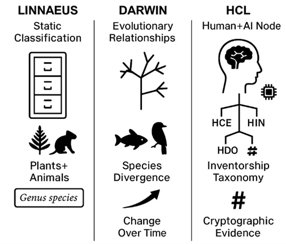
Figure 2. From classification of entities to classification of conception and contribution. Conceptual progression from Linnaean classification of observable entities and Darwinian organization of biological relationships and change to a Human Conception Ledger taxonomy capable of representing human conception, reasoning, contribution, and decision events within evolving human–AI workflows.
The emergence of machine-readable AI watermarking represents an important step toward greater transparency in an increasingly synthetic information environment. But identifying AI involvement addresses only one side of the provenance problem.
As AI becomes embedded in scientific, professional, creative, and commercial work, the more difficult question may increasingly become not whether AI participated, but what the human actually contributed.
The Human Conception Ledger is proposed as one framework for preserving that record.
The goal is not to separate humans from AI. It is to ensure that, in an age of increasingly powerful AI, human conception, contribution, judgment, and decision-making remain visible, attributable, and preservable.
Companion Technical Papers
Human Conception Ledger (HCL): A Framework for Provenance, Attribution, and Human Inventorship in AI-Augmented Systems
Team Contribution Attribution Ledger (TCAL): A Framework for Distributed Human Contribution Aggregation and Attribution in AI-Augmented Systems
Primary Source on Claude Marking
Anthropic, “How Claude marks AI-generated content,” Claude Help Center, updated 10 August 2026.

Comments